How Do AI Workflows Differ From Traditional Automation?
Prachi Wadhwa
Author
Here's a scenario every operations leader knows: You've automated a process that works beautifully—until it doesn't. A vendor sends an invoice in a new format. A customer asks a question that doesn't match your scripted responses. An approval needs to go to someone who's out of office. Suddenly, your automation stops, creates an error ticket, and a human has to step in.
This is the fundamental limitation of traditional automation. And it's exactly what AI workflow automation was designed to overcome.
Understanding the difference between these approaches isn't academic—it determines which processes you can automate, how much value you'll extract, and whether your automation strategy actually scales.
The Core Architectural Differences
Decision-Making Philosophy
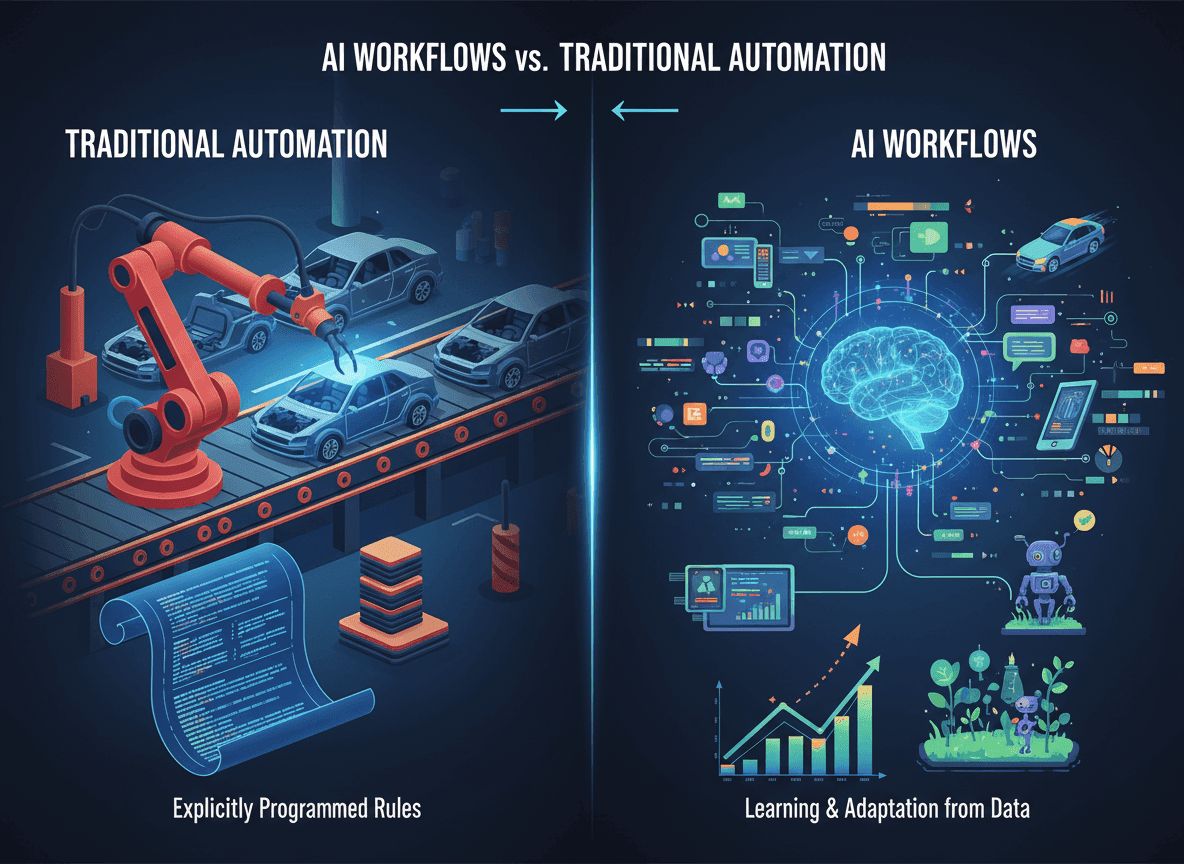
Traditional automation operates on explicit, deterministic rules. It follows IF–THEN logic: if condition X is met, then execute action Y. Every decision point must be anticipated and programmed in advance.
AI workflow automation operates on pattern recognition and contextual understanding. It doesn’t need every scenario mapped out because it can interpret situations, apply learned patterns, and make reasoned decisions based on training and examples.
Consider a customer refund request. Traditional automation can check if the request is within 30 days and the amount is under $100, then automatically approve it. But if the customer is a VIP with a history of returns, received a defective product, and is threatening to leave, traditional automation either rejects the request or escalates it for human review.
AI workflow automation reads the request, understands the context, recognizes customer value and frustration, weighs policy against retention risk, and makes a judgment call—or escalates with full context to a human for a final decision.
Handling Variability and Exceptions
This is where the gap between the two approaches becomes a chasm.
Traditional business automation requires standardization. Inputs must conform to predefined templates and structures. When reality doesn’t match the design, the automation fails.
Research from MIT’s Work of the Future initiative shows that traditional automation projects spend 60–70% of implementation time handling exceptions—and many still break when unexpected variations occur.
AI workflows embrace variability. An AI agent processing invoices doesn’t need a template. It extracts information from PDFs, emails, scanned images, or screenshots because it understands what an invoice is conceptually.
This fundamentally changes the economics of automation. Processes once considered “too variable to automate” become ideal candidates for AI workflow automation.
Learning and Adaptation
Traditional automation is static. The workflow deployed on day one behaves the same on day one thousand unless manually updated.
AI workflow automation improves continuously. AI agents analyze outcomes, identify successful patterns, and adapt their behavior over time.
A customer support workflow may learn that certain issues resolve faster when routed to specific agents, that certain phrases indicate churn risk, or that specific response styles improve satisfaction—and incorporate those learnings automatically.
Practical Comparison Across Key Dimensions
Implementation Complexity
Traditional automation is simpler for linear processes with few exceptions. Tools like Zapier or Microsoft Power Automate can be deployed in hours. However, such ideal workflows are increasingly rare.
AI workflow automation requires more upfront design—training agents, integrating systems, and defining escalation logic—but handles real-world complexity far better.
A 2024 UiPath study found that traditional automation averaged 6–8 weeks to deploy, plus 3–4 additional weeks fixing post-launch exceptions. AI workflows took 8–10 weeks initially but required minimal post-launch rework.
Maintenance Requirements
Traditional automation requires frequent maintenance. System changes, form updates, or process evolution require manual rework. Organizations spend 20–40% of automation budgets on upkeep.
AI workflows are more resilient. Format changes, new product categories, or minor process shifts are handled through pattern recognition rather than reprogramming. Maintenance focuses on optimization, not survival.
Cost Structure
Traditional automation has lower upfront costs but higher long-term expenses due to maintenance, exception handling, and redesigns.
AI workflow automation requires higher initial investment but lowers ongoing costs through adaptability and reduced manual intervention.
One finance director shared: “Traditional automation saved us $50,000 in year one but cost $30,000 annually to maintain. Our AI workflows cost $120,000 upfront but only $15,000 per year to maintain. By year three, AI was cheaper—and far more capable.”
When to Use Each Approach
Ideal Use Cases for Traditional Automation
- Highly standardized, low-variation processes
- Binary decision logic
- Simple, cost-sensitive tasks
- Strict audit and predictability requirements
Ideal Use Cases for AI Workflow Automation
- Unstructured or variable inputs
- Context-dependent decision making
- Judgment-heavy processes
- Frequent exceptions (10–15%+)
- Workflows that benefit from learning over time
The Hybrid Future
Combining Both Approaches
Leading organizations use traditional automation for deterministic steps and AI agents for interpretation, decision-making, and adaptation.
One team described it as: “Traditional automation is the plumbing. AI agents are the workers. Together, they’re stronger than either alone.”
Migration Strategies
- Target workflows with high exception rates
- Run AI and traditional systems in parallel initially
- Build internal AI workflow design capabilities
Making the Right Choice for Your Organization
The choice between traditional automation and AI workflow automation is strategic, not binary.
Traditional automation remains ideal for predictable, high-volume processes. AI workflow automation is essential where variability, context, and judgment dominate.
The organizations succeeding today are experimenting early, learning quickly, and building intelligent automation that evolves with their business.
Internal Links
- What Is AI Workflow Automation and Why Is Everyone Talking About It?
- What Does an End-to-End AI Workflow Look Like in Practice?
Sources
- MIT Work of the Future Initiative (2024). Automation and the Future of Work
- UiPath (2024). State of Automation Report: AI vs Traditional Approaches
- Forrester Research (2024). The Total Economic Impact of Intelligent Automation
- Harvard Business Review (2024). When to Automate with AI vs. Traditional Tools