Is AI Really Replacing Jobs or Just Changing Them?
Prachi Wadhwa
Author
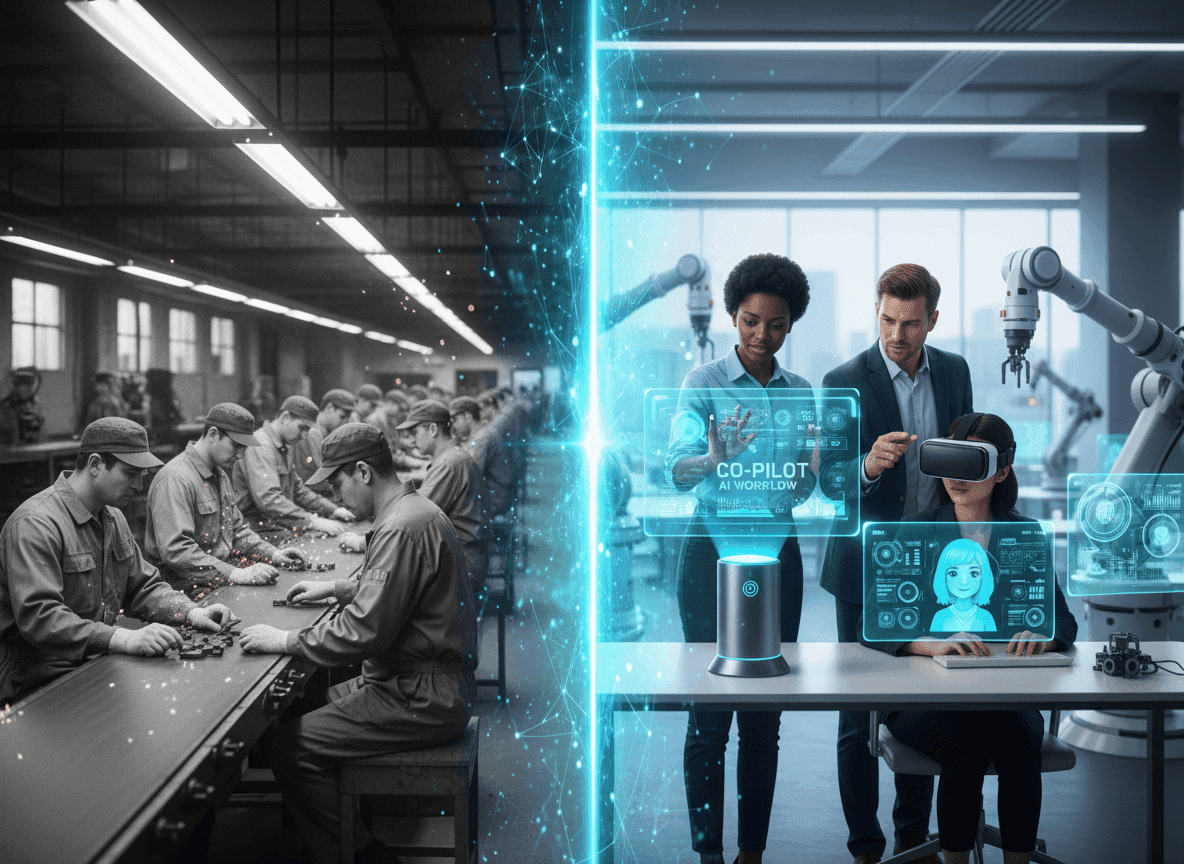
The question keeps business leaders awake and employees anxious: Is artificial intelligence coming for our jobs? Walk into any break room, scroll through LinkedIn, or attend an industry conference, and you’ll encounter the same tension—fear mixed with fascination, worry tempered by curiosity.
The honest answer requires nuance that headlines rarely capture. Yes, AI is replacing certain jobs. And yes, AI is transforming far more jobs than it’s eliminating. The distinction matters enormously for how businesses plan their workforce and how individuals navigate their careers.
Let’s cut through the hype and examine what’s actually happening in businesses deploying AI agents and digital employees today.
The Data Behind the Headlines
What the Research Actually Shows
Goldman Sachs Economics Research estimated that AI could automate the equivalent of 300 million full-time jobs globally—but the nuance is critical. AI is projected to impact about 25% of work tasks, not eliminate 25% of jobs.
McKinsey’s 2024 study of 2,000 companies found average headcount reductions of just 3%, alongside productivity gains of 20–30%. Those gains came from employees working with AI tools, not being replaced by them.
The World Economic Forum’s Future of Jobs Report 2025 projects 85 million jobs displaced by 2027—but 97 million new roles created. This is job transformation at scale.
LinkedIn workforce data shows job postings requiring AI skills rose 270% between 2023 and 2025, even as overall tech hiring declined. Companies are hiring differently, not necessarily less.
The Pattern Emerging Across Industries
In customer service, AI chatbots handle 60–75% of initial inquiries, yet contact-center employment declined only 8%. Human agents now focus on complex, empathetic, and judgment-heavy work.
In financial services, AI handles data gathering and validation. Analysts spend most of their time on insight generation and strategy instead of spreadsheets.
Manufacturing roles evolved into data-centric positions overseeing AI quality and maintenance systems. Workers who adapted saw salary increases averaging 18%.
Understanding the Three Categories of AI Impact
Category 1 – Jobs Being Replaced
Some roles are being eliminated. These include:
- Routine data entry positions
- Basic content moderation roles
- Standardized report generation jobs
- Script-based customer service roles
- Basic bookkeeping and transaction categorization
These roles share common traits: repetitive tasks, minimal judgment, and structured inputs. According to the U.S. Bureau of Labor Statistics, data-entry employment fell 23% between 2023 and 2025.
Category 2 – Jobs Being Transformed
Most roles aren’t disappearing—they’re evolving.
Customer service representatives now handle complex issues instead of FAQs. Accountants focus on strategy rather than reconciliation. Recruiters evaluate culture fit instead of scheduling interviews. Sales reps spend time building relationships rather than qualifying leads.
The pattern is consistent: AI executes; humans judge, create, and connect. As one leader put it, “We’ve gone from doing work to directing work.”
Category 3 – Jobs Being Created
Entirely new roles are emerging:
- AI workflow designers
- Digital employee managers
- AI ethics and governance specialists
- Prompt engineers and AI trainers
- Human–AI collaboration specialists
LinkedIn reports these roles grew 340% between 2023 and 2025, with salaries 25–40% higher than comparable legacy roles.
The Real Disruption: Skill Shift, Not Job Loss
What Skills Matter Now
- Judgment in ambiguous situations
- Emotional intelligence and empathy
- Creative and strategic problem-solving
- Cross-functional collaboration
The AI Literacy Imperative
AI literacy—understanding what AI can do, how to guide it, and when to override it—is becoming essential. Research shows AI-literate workers are 3–5x more productive than those who are not.
Companies with structured AI upskilling programs achieve nearly 3x higher productivity gains and significantly higher employee satisfaction.
How Companies Are Managing the Transition
The Redeployment Strategy
Successful organizations automate tasks, not people. Workers are retrained and redeployed into higher-value roles requiring judgment and empathy.
The Hybrid Team Model
Teams increasingly consist of humans supervising multiple AI agents. Output scales while human headcount remains stable, requiring new management skills for hybrid teams.
What This Means for Different Stakeholders
For Business Leaders
Transparency, reskilling, and employee involvement are key. Leaders who measure success by innovation and productivity—not just cost reduction— achieve the best outcomes.
For Workers
Career resilience now depends on adaptability, continuous learning, AI literacy, and focusing on uniquely human strengths.
For Society and Policymakers
Education reform, reskilling programs, transition support, and responsible AI policy are essential to ensure the benefits of AI are broadly shared.
The Five-Year Outlook
By 2030, AI will handle most routine cognitive work, while human roles will emphasize judgment, creativity, and relationships. Employment levels will remain relatively stable—but skill requirements will shift rapidly.
AI is both replacing and changing jobs—but change overwhelmingly dominates. The future of work isn’t humans versus AI. It’s humans working with AI to create value neither could generate alone.
Internal Links
- Which Jobs Can AI Agents Replace Today?
- How Are Companies Using AI to Replace Entire Roles?
- What Are Digital Employees and How Do They Work?
- Will AI Replace My Job and What Should I Do?
Sources
- Goldman Sachs (2023). The Effects of AI on Economic Growth
- McKinsey & Company (2024). The State of AI: Workforce Impact
- World Economic Forum (2025). Future of Jobs Report
- LinkedIn (2025). AI Skills and Employment Trends
- Salesforce (2024). State of Service Report
- MIT & Harvard (2024). AI Productivity Gap Study
- U.S. Bureau of Labor Statistics (2025). Occupational Employment Data