Is AI Workflow Automation Better Than Zapier or RPA?
Prachi Wadhwa
Author
AI Workflow Automation vs. Zapier vs. RPA: What Actually Wins in 2026?
For a decade, business automation was defined by rigidity. You programmed a path, and the computer followed it blindly. If a single pixel moved or a data format changed, the automation broke.
In 2026, we’ve entered the Era of Autonomy. AI workflow automation—often called Agentic AI—doesn’t just follow scripts. It understands goals.
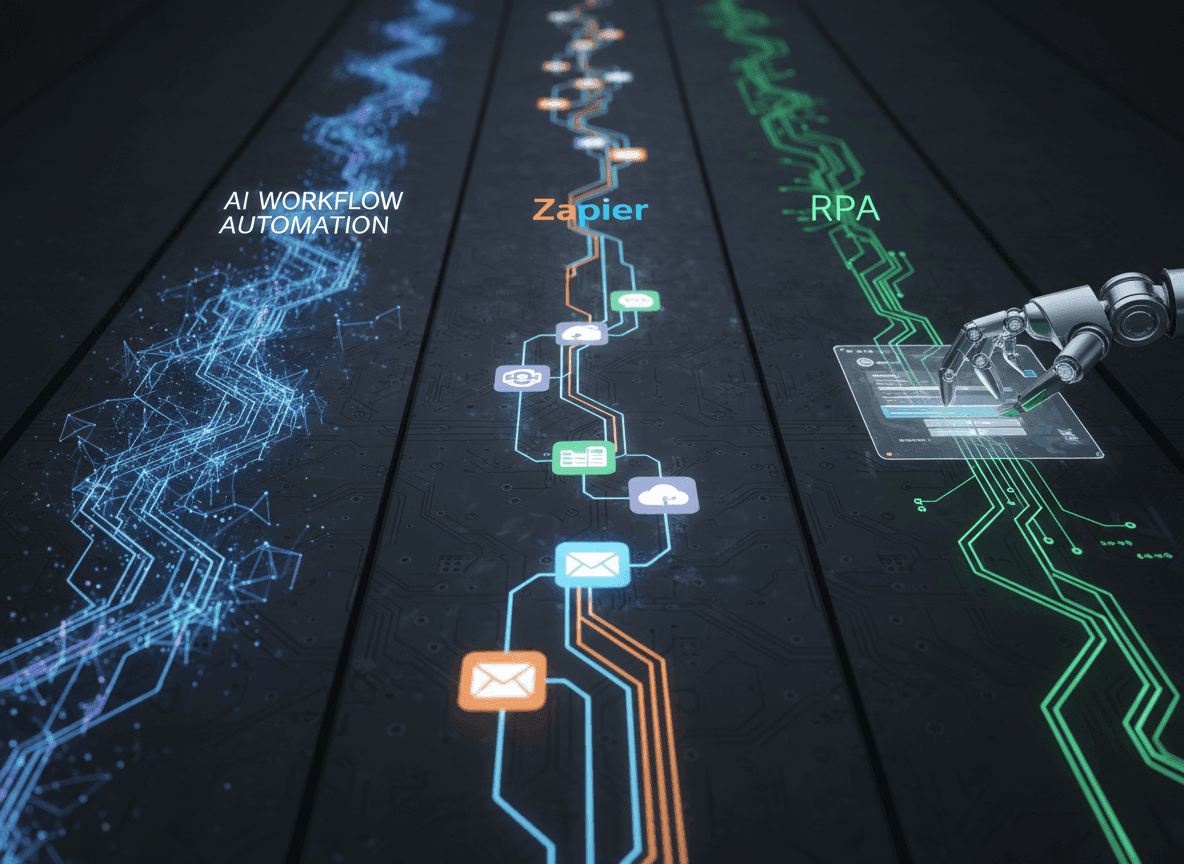
This shift has split the automation market into three distinct categories:
- Zapier (The Connector): The plumbing of the internet.
- RPA (The Mimic): The hands that interact with legacy software.
- AI Agents (The Brain): Digital employees that reason, decide, and adapt.
Why AI Workflow Automation Wins the Complexity Battle
Enterprises are adopting AI agents not because of hype, but necessity. Modern work is messy, unstructured, and constantly changing. Traditional automation tools are allergic to ambiguity.
1. Reasoning vs. Rules
Zapier / RPA:
If a customer sends an email with an attachment, the automation saves it. If the customer says, “I want a refund because my dog chewed the box,” the system fails—there is no predefined rule for that scenario.
AI Agent:
Reads the email, understands sentiment, checks return policies for damaged goods, and makes a judgment call or escalates with full context.
Rules execute. Agents decide.
2. Self-Healing vs. Constant Maintenance
RPA bots break when a UI element changes. AI agents use semantic reasoning and computer vision to identify intent rather than pixels, reducing maintenance costs by an estimated 60%.
3. Goal-Driven Execution vs. Step Mapping
Zapier requires mapping every step. AI workflows start with a goal: “Find 10 ICP-matched prospects and draft personalized outreach.” The agent plans and executes autonomously.
When Zapier Is Still the Right Tool
Zapier excels when workflows are:
- Deterministic (trigger → action)
- Simple and structured
- High-volume and low-logic
- Cost-sensitive at scale
When predictability matters more than intelligence, Zapier is unbeatable.
When RPA Is Still the Right Tool
RPA remains essential for legacy systems without APIs, especially in regulated environments.
- Works with mainframes and old UI-based systems
- Provides deterministic, auditable execution
- Meets strict compliance requirements
Comparison at a Glance (2026)
| Feature | Zapier | RPA | AI Workflow (Agent) |
|---|---|---|---|
| Logic | IF-THIS-THEN-THAT | Fixed Scripts | Reasoning & Planning |
| Input | Structured Data | UI Elements | Text, Voice, Images |
| Failure Mode | Breaks on data change | Breaks on UI change | Re-evaluates and adapts |
| Learning | None | None | Continuous |
| Setup Time | Minutes | Weeks / Months | Days |
| Maintenance | Low | Very High | Moderate |
Case Study: The Hybrid Stack
Insurance Claim Workflow:
- Zapier captures form data and stores it.
- AI Agent analyzes documents, photos, and context.
- RPA logs into a legacy claims system and issues payment.
A process that once took 14 days now completes in hours—without human intervention.
ROI in 2026: A New Lens
RPA ROI is measured in FTE displacement. AI agent ROI is measured in opportunity capture—doing things that were previously impossible.
The Verdict
Yes, AI workflow automation is better when judgment and adaptability are required.
No, it is not better for purely repetitive, deterministic tasks where Zapier or RPA are cheaper and more reliable.
How to Transition in 2026
- Identify where automations break due to messy data.
- Insert AI reasoning into existing Zapier or RPA flows.
- Use goal-based agents for new, complex workflows.
Conclusion
Zapier is the foundation. RPA is the muscle. AI agents are the mind. Enterprises that combine all three will scale faster and adapt longer.
You need the foundation to stand—but you need the brain to grow.