Is No-Code or Low-Code Better for Building AI Agents?
Prachi Wadhwa
Author
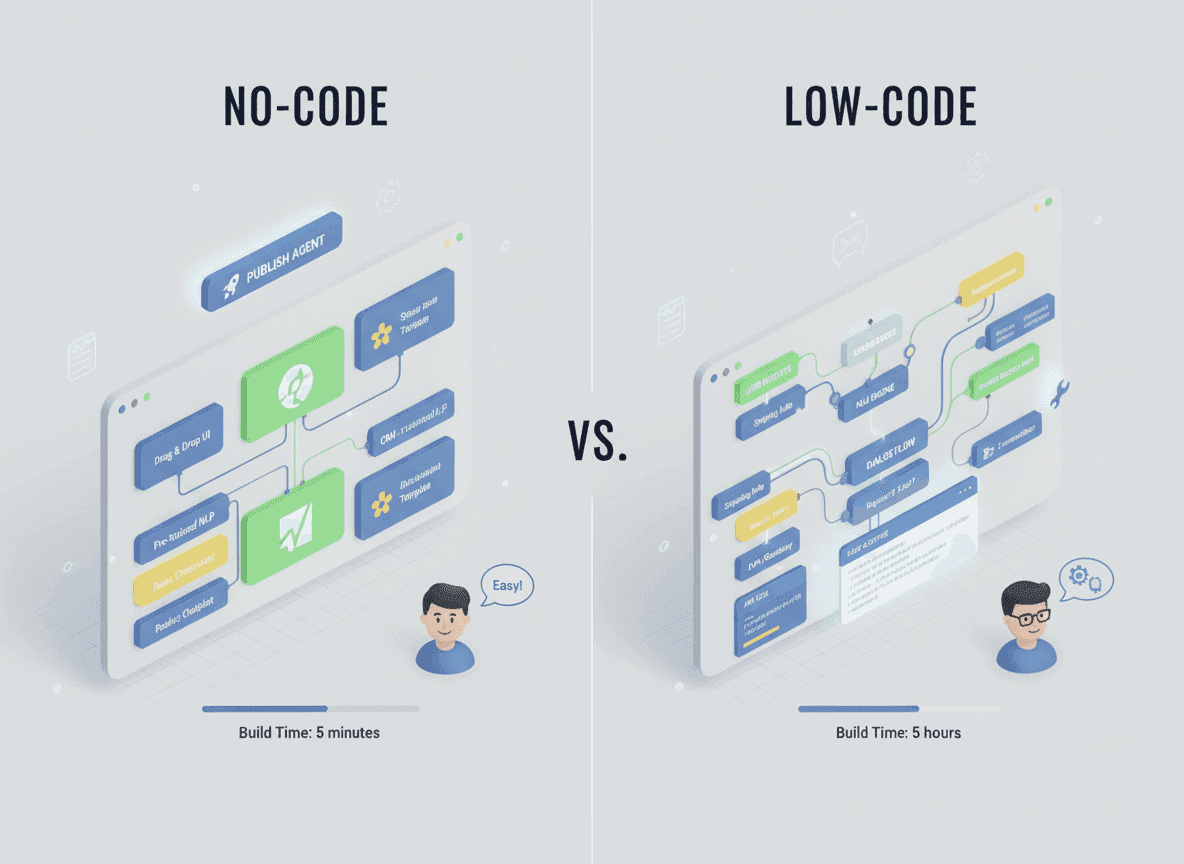
By 2026, the question is no longer whether you can build an AI agent—it's how much control you are willing to trade for speed. The rise of Agentic AI has created two distinct paths for B2B organizations: No-Code, built for rapid deployment, and Low-Code, built for enterprise-grade customization.
Choosing the wrong foundation can introduce technical debt that forces a complete rebuild within months. This guide breaks down the strengths, weaknesses, and ideal use cases for both approaches.
Defining the 2026 Standard: No-Code vs. Low-Code
Although often grouped together, no-code and low-code platforms solve very different problems in the modern tech stack.
No-Code: The “Plug-and-Play” Workforce
No-code platforms such as Lindy.ai or Zapier Central rely on visual drag-and-drop interfaces and natural language instructions (“Vibe Coding”). You describe what the agent should do, and the platform manages APIs, infrastructure, and security.
Primary goal: Empowering citizen developers in HR, Sales, and Operations to build solutions without waiting for IT.
Low-Code: The “Power User” Canvas
Low-code platforms like Microsoft Copilot Studio or Botpress start with visual workflows but allow developers to inject custom JavaScript or Python when needed.
Primary goal: Accelerating professional developers while preserving full control over complex business logic.
Head-to-Head Comparison Matrix
| Feature | No-Code Agents | Low-Code Agents |
|---|---|---|
| Speed to Live | Hours to days | Weeks |
| Technical Skill Required | None | Basic JS/Python + APIs |
| Integration Depth | Pre-built connectors only | Unlimited via custom code |
| Initial Cost | Low (subscription-based) | Moderate (developer time + licenses) |
| Security Control | Platform-dependent | Granular, enterprise-grade |
When No-Code Is the Clear Winner
No-code is not a “starter” option—it is a deliberate choice for speed. By 2026, no-code platforms comfortably handle roughly 80% of standard business workflows.
Rapid Prototyping and MVPs
If you need to validate a hypothesis quickly—such as testing whether an AI agent can pre-screen inbound leads—no-code is ideal. You can deploy an agent in hours, not weeks, and validate ROI at minimal cost.
Routine Departmental Workflows
Tasks like meeting summaries, social post drafting, and basic support ticket triage do not require custom code. Templated logic in no-code tools is more than sufficient.
When Low-Code Is the Only Option
As an agent evolves from a productivity helper into core infrastructure, no-code limitations become clear. This is where low-code excels.
Complex Multi-Step Logic
Workflows involving advanced branching—such as loyalty checks, inventory validation, custom pricing formulas, and multi-system updates—become unwieldy in no-code. Low-code enables clean, maintainable logic through small scripts.
Legacy System Integration
No-code platforms integrate best with modern SaaS tools. Legacy ERPs or on-premise databases without public APIs often require custom bridges that only low-code environments can provide.
High-Stakes Security and Compliance
In regulated industries like finance and healthcare, opaque no-code platforms may fail audits. Low-code environments allow precise control over data residency, masking, and permissioning.
The Hidden Cost of “Free” and “Easy”
No-code tools offer low upfront cost, but long-term ROI requires careful consideration.
- No-Code Lock-in: Agent logic is often non-portable; switching platforms may require a full rebuild.
- Low-Code Maintenance: Greater flexibility comes with the need for ongoing technical ownership when APIs or systems change.
Conclusion: The Hybrid Strategy
In 2026, leading organizations adopt a bimodal approach:
- No-Code at the Edge: Departments rapidly build lightweight agents for everyday productivity.
- Low-Code at the Core: Central IT and Ops teams maintain mission-critical agents handling customer and financial data.
The verdict: If you need a solution today, choose no-code. If you are building infrastructure meant to last years, invest in low-code.