What Are Digital Employees and How Do They Work?
Prachi Wadhwa
Author
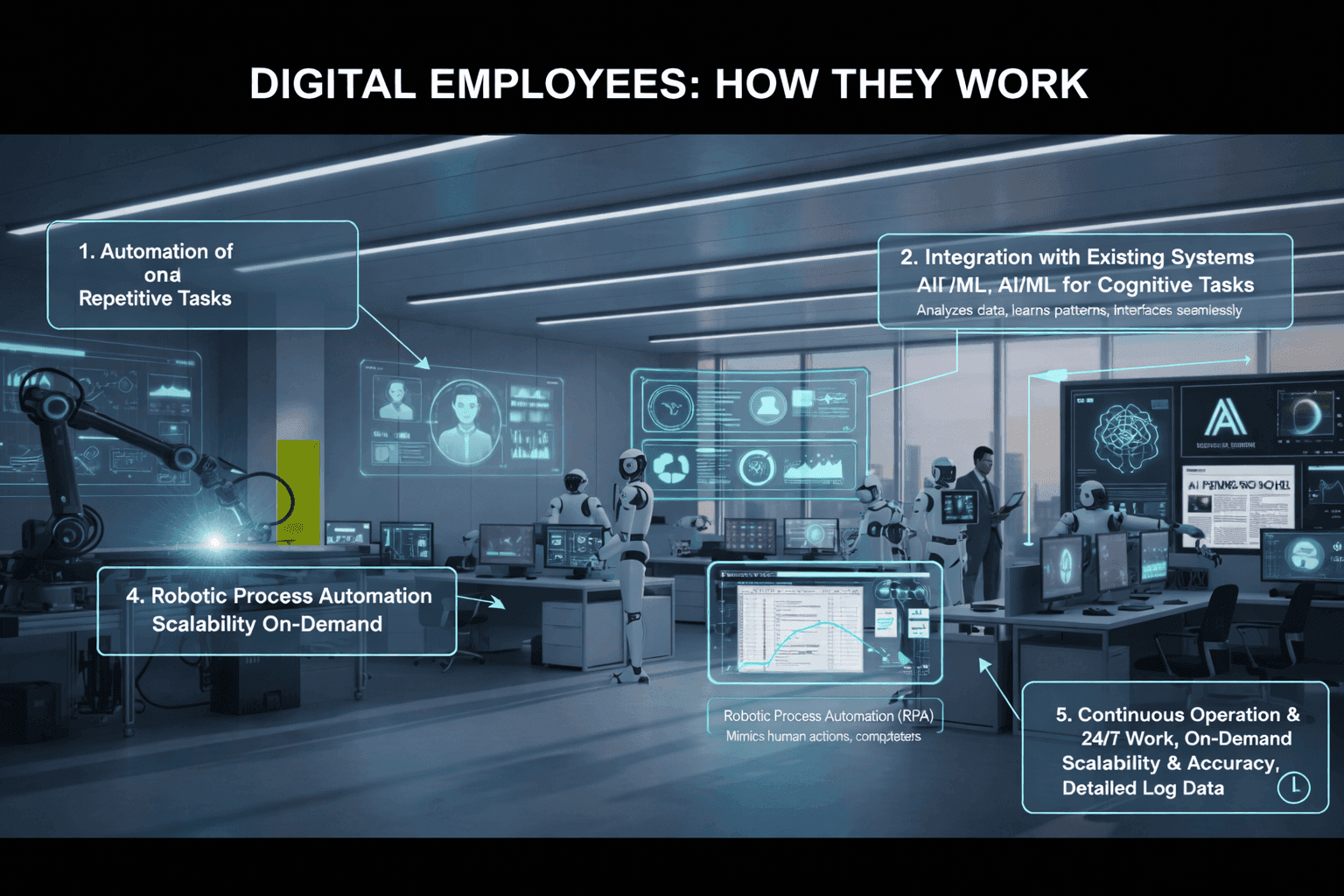
To understand how a digital employee works, we must first distinguish it from the technologies that came before it. In the early 2020s, we had chatbots (which talked) and RPA (which moved data).
In 2026, a digital employee is the synthesis of both—plus a reasoning layer.
- Identity & Credentials: A digital employee has its own corporate identity—login, email address, and defined security permissions.
- Role-Based, Not Task-Based: Instead of performing one task (e.g., “save an invoice”), it owns a role (e.g., “Accounts Payable Clerk”) and manages the full lifecycle.
- Agency: Once given a goal, it plans and executes sub-tasks autonomously without waiting for constant human triggers.
The Architecture: How a Digital Employee “Thinks”
The intelligence of a digital employee comes from its cognitive architecture. In 2026, this is typically composed of four core modules.
1. The Core (The Brain)
At the center is a large language model (LLM) such as GPT-5 or Claude 4. This core is used for reasoning, not just text generation. It breaks down high-level instructions into logical action sequences using a chain-of-thought process.
2. Memory (The Context)
Digital employees rely on two types of memory:
- Short-term (Working) Memory: Maintains context for the current task, such as details of a specific insurance claim.
- Long-term (Persistent) Memory: Stores past experiences and preferences—often via vector databases—to improve future decisions.
3. Tool Use (The Hands)
Through protocols like the Model Context Protocol (MCP), digital employees access enterprise tools. They interact with CRMs, databases, internal portals, and APIs just like human employees.
4. The Orchestration Layer (The Guardrails)
This layer enforces company policies and permissions. If a digital employee attempts an action outside its authority—such as approving a large expenditure—the action is blocked and escalated to a human supervisor.
A Day in the Life of a Digital Employee
Consider “Alex,” a Digital HR Specialist at a mid-sized tech firm.
Goal Initialization
The HR Director assigns a goal: “Onboard the five new engineers starting Monday.”
Planning
Alex consults onboarding policies and identifies required steps:
- Create email accounts
- Send welcome packages
- Schedule team introductions
- Collect tax documentation
Execution
Alex provisions accounts via IT systems, coordinates schedules through calendars, and communicates with managers through Slack.
Exception Handling
When one engineer fails to sign their contract, Alex sends a reminder and alerts the HR lead without blocking the rest of the process.
Completion
By Friday, Alex reports: “4 of 5 engineers fully onboarded; 1 pending signature.”
The 2026 Hybrid Workforce Model
Digital employees enable a hybrid workforce where humans and AI collaborate.
1. From Doing to Orchestrating
Humans increasingly act as orchestrators, managing teams of digital employees that handle execution.
2. AgenticOps (Agentic Operations)
Organizations create AgenticOps teams to maintain digital employees, monitor performance, and manage tools and models.
3. Continuous Learning
Human-in-the-loop feedback allows digital employees to learn from corrections, improving performance over time.
Challenges and Governance
- Hallucinations: Reasoning errors still occur, making guardrails essential.
- Security: Non-human identities introduce new attack surfaces, requiring zero-trust approaches.
- Culture: Organizations must invest in AI literacy so employees view digital coworkers as collaborators, not competitors.
Conclusion
Digital employees represent the shift from software that enables work to software that performs work. In 2026, the critical question is not whether to use AI, but how to integrate digital coworkers effectively.
By understanding reasoning, memory, and tool use, organizations can move beyond hype and build a workforce that is faster, more accurate, and infinitely scalable.