What Is an AI Agent Builder and How Does It Work?
Prachi Wadhwa
Author
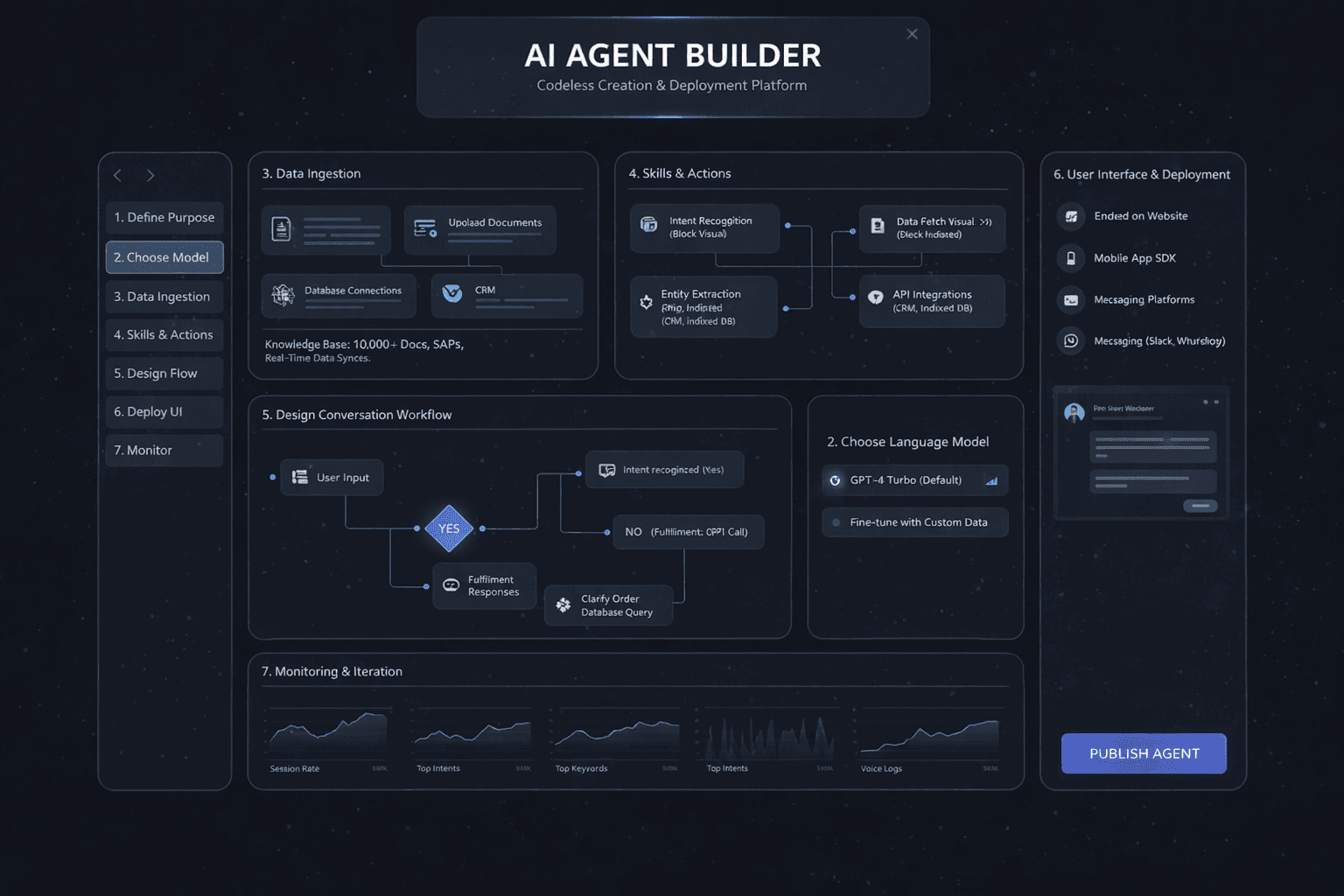
In 2026, the term “software developer” is being redefined. With the rise of AI agent builders, the ability to create complex, autonomous systems is moving from specialized engineers to operations leaders and product managers.
An AI agent builder is more than a chatbot creator. It is a factory for digital employees. While a chatbot talks, an agent built on these platforms acts. These builders provide the brain (LLM), the memory (vector databases), and the hands (APIs) required for software to solve problems independently.
The Core Anatomy: How an AI Agent Actually “Thinks”
To understand how a builder works, you must understand the four architectural layers it assembles:
1. The Reasoning Engine (The Brain)
The core of the agent is usually a Large Language Model (LLM) such as GPT-4o, Claude 3.5, or Gemini 1.5 Pro. The builder allows you to “prime” this brain using system prompts that define the agent’s persona, scope, and behavioral boundaries.
2. The Planning Layer (The Strategy)
This layer is what separates agents from simple bots. Most builders implement frameworks like ReAct (Reason + Act).
How it works: When given a goal, the agent does not respond immediately. It creates a step-by-step plan, executes the first step, observes the outcome, and continuously refines the plan until the objective is achieved.
3. Memory & Context (The Archive)
Agents must remember past interactions and institutional knowledge.
- Short-term memory: Maintains awareness of the current task or conversation.
- Long-term memory: Uses Retrieval-Augmented Generation (RAG) to access company PDFs, databases, policies, and knowledge bases.
4. Tool-Use & Skillsets (The Hands)
This layer enables real-world action. Through function calling and API access, an agent can execute tools such as Search CRM, Send Email, or Generate Invoice—turning reasoning into execution.
Types of AI Agent Builders: No-Code to Pro-Code
| Type | Target User | Examples | Best For |
|---|---|---|---|
| No-Code | Ops Managers, Founders | Lindy.ai, Relevance AI, Zapier Central | Rapid automation of standard workflows (e.g., lead generation) |
| Low-Code | Product Managers, IT | Microsoft Copilot Studio, MindOS | Enterprise-grade agents with complex internal logic |
| Pro-Code | Software Engineers | LangGraph, CrewAI, AutoGen | Mission-critical and highly proprietary systems |
The 5-Step Workflow: From Prompt to Production
- Define the Goal: Example: “Find overdue invoices and negotiate payment plans.”
- Connect Knowledge: Upload policies and connect accounting or CRM APIs.
- Establish Guardrails: Define hard rules (e.g., “Never offer a discount over 15%”).
- Sandbox Testing: Simulate edge cases before going live.
- Deployment & Monitoring: Launch the agent and track success rate, latency, and errors.
Why Traditional RPA Is Being Replaced by Agent Builders
Robotic Process Automation (RPA) dominated the 2010s by mimicking human clicks. However, it fails when interfaces change.
AI agent builders rely on semantic understanding and visual perception. If a button moves, the agent recognizes the intent—not the pixel location—allowing it to self-heal. This capability is why Gartner predicts that 40% of enterprise applications will embed task-specific agents by the end of 2026.
Key Features to Look for in an Agent Builder
- Model Agnostic: Ability to switch between OpenAI, Anthropic, or open-source models.
- Observability: Trace logs explaining why an agent took a specific action.
- Human-in-the-Loop (HITL): Optional approval before critical actions.
- Security & Compliance: SOC2 Type II, data masking, and PII protection.